

Most nonprofits don't have a Salesforce problem
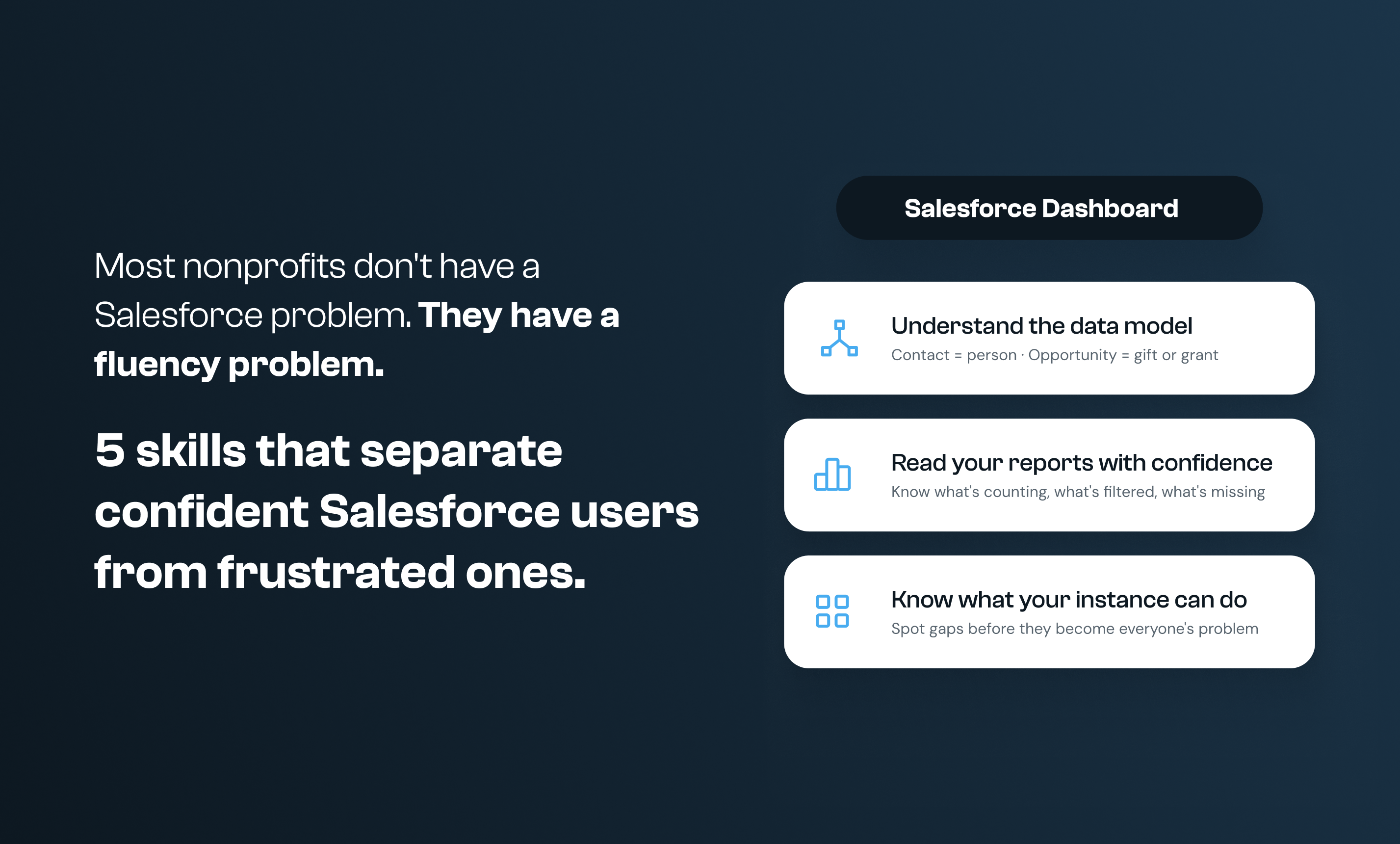
Most nonprofits don't have a Salesforce problem. They have a fluency problem.
The software works. The data's in there, mostly. The reports run. But walk into a dev team meeting or an ED's office and ask a straight question — how many sustainers did we lose last quarter, and why? — and what you'll often get is a pause, a shrug, and a Slack message to the admin.
That's not a technology issue. That's a fluency issue. And it's solvable.
What I mean by fluency
Fluency isn't certification. You don't need to become a Salesforce admin to be fluent — the same way you don't need to be a mechanic to drive a car confidently.
Fluency means you can:
• Navigate the system without breaking it.
• Read a report and know if it's answering the right question.
• Spot when a dashboard is lying to you.
• Ask your admin a good question instead of a vague one.
• Tell the difference between “Salesforce can’t do this” and “nobody’s set that up yet.”
That's a different skill from the admin track. And for most nonprofit staff — development directors, program managers, operations leads, executive directors — it's the skill that actually matters day to day.
Why the fluency gap is so big in nonprofits
A few reasons, and none of them are anyone's fault.
Salesforce is configurable, which means no two orgs look alike
The Salesforce your peer nonprofit uses is not the Salesforce you use. Generic training only gets you so far.
Most training is admin-biased
Trailhead is excellent, but it's built to make admins. If you're a development director who just wants to understand how soft credits work, you end up wading through modules on flows and validation rules you'll never touch.
Implementation happens once, training happens never
A consultant sets up the org, trains two people, and leaves. Those two people leave or move roles. Two years later, nobody on staff actually knows how the thing is supposed to work.
The data model was built for sales teams
“Opportunity” means donation. “Account” can mean a household, an organization, or neither depending on which model you’re on. The vocabulary itself is a barrier.
None of this is a reason to give up on Salesforce. It's a reason to take fluency seriously.
The five things a fluent nonprofit user actually knows
I've seen a lot of Salesforce orgs at this point. The staff who get the most out of the platform — regardless of role — tend to share the same handful of skills.
1. They understand the data model in nonprofit language
They know that a Contact is a person, an Account is usually a household or organization, and an Opportunity is a gift or grant. They know the difference between NPSP, Nonprofit Cloud, and Agentforce Nonprofit — not in detail, but enough to know which one they're on and what that implies.
They don't need to name every object. They just need a mental map that matches how their organization actually works.
2. They can read a report
Not build one — read one. That means: looking at a report and being able to say “this is counting households, not individuals,” or “this date filter is grouped by close date, not created date, so it’s going to miss pledged gifts.”
Half the reporting arguments I've watched in nonprofits come down to two people looking at two reports that answer slightly different questions and thinking they're looking at the same number. Fluent users catch that before it becomes an all-hands fire drill.
3. They treat data hygiene as part of their job
Duplicates, blank fields, stale records, inconsistent picklists — these aren't the admin's problem alone. They're everyone's problem, because every bad record makes every report a little less trustworthy.
Fluent users know when to enter something, when to update, and when to stop and flag a data quality issue instead of pressing save on something they know is wrong.
4. They know how to write a good change request
“Can we add a field?” is not a change request. “We need to track second-gift conversion for sustainers acquired through events, and right now we can’t tell those apart from organic sustainers — can we talk through options?” is a change request.
The difference is context. Fluent users give their admin (or consultant) the why, not just the what. That one habit saves more time and money than any other skill on this list.
5. They know what their instance can and can't do
This is the one most people miss. A fluent user knows roughly what their Salesforce org is capable of today, and what it would take to extend it. They don't ask for things that are already built. They don't assume things are impossible when they're just unconfigured. And when something's genuinely a stretch, they know it's a stretch before they ask.
Fluency by role
Different roles need fluency in different things. A rough guide:
Development and fundraising
Opportunity stages, soft credits, recurring gifts, pledged vs. paid, campaign hierarchy, donor journeys. If you run gift entry or moves management, this is your vocabulary.
Programs
Case management, engagement tracking, participants, services delivered, outcomes. Whether you're on Program Management Module, Nonprofit Cloud's Program Management, or something custom — knowing how activity and impact flow through the system is the core skill.
Operations and finance
Reconciliation, GL coding on opportunities, reporting for audit and 990 prep, sustainer processing, refund and adjustment handling. The unsexy stuff that breaks first when something's off.
Leadership
The dashboards an ED actually needs. Not thirty — three to five. Pipeline, retention, program throughput, maybe cash flow. Fluency at the leadership level means knowing what you're looking at, and trusting it.
How to get there
The honest answer: you get there through use, not courses. But a few things help.
Pick three reports you rely on and learn them cold
Not how to build them — how they work. What objects they pull from. What filters they apply. What they miss. Once you understand three, the fourth is easier.
Shadow your admin for an hour
Not to learn what they do, but to see what questions they're answering. You'll realize a lot of what feels mysterious is just invisible labor.
Find one peer
At another nonprofit, in a user group, wherever. Someone in your role who's further along. Most of my best Salesforce conversations started that way.
Audit your instance honestly
Once a year at minimum. Not a formal deep-dive, just: what’s still being used, what’s rotted, what’s confusing. Our Salesforce Health Check takes about five minutes and gives you a starting point — it’s free, and it’s a reasonable place to begin if you don’t know where else to start.
If you're on NPSP, take stock of where things are heading
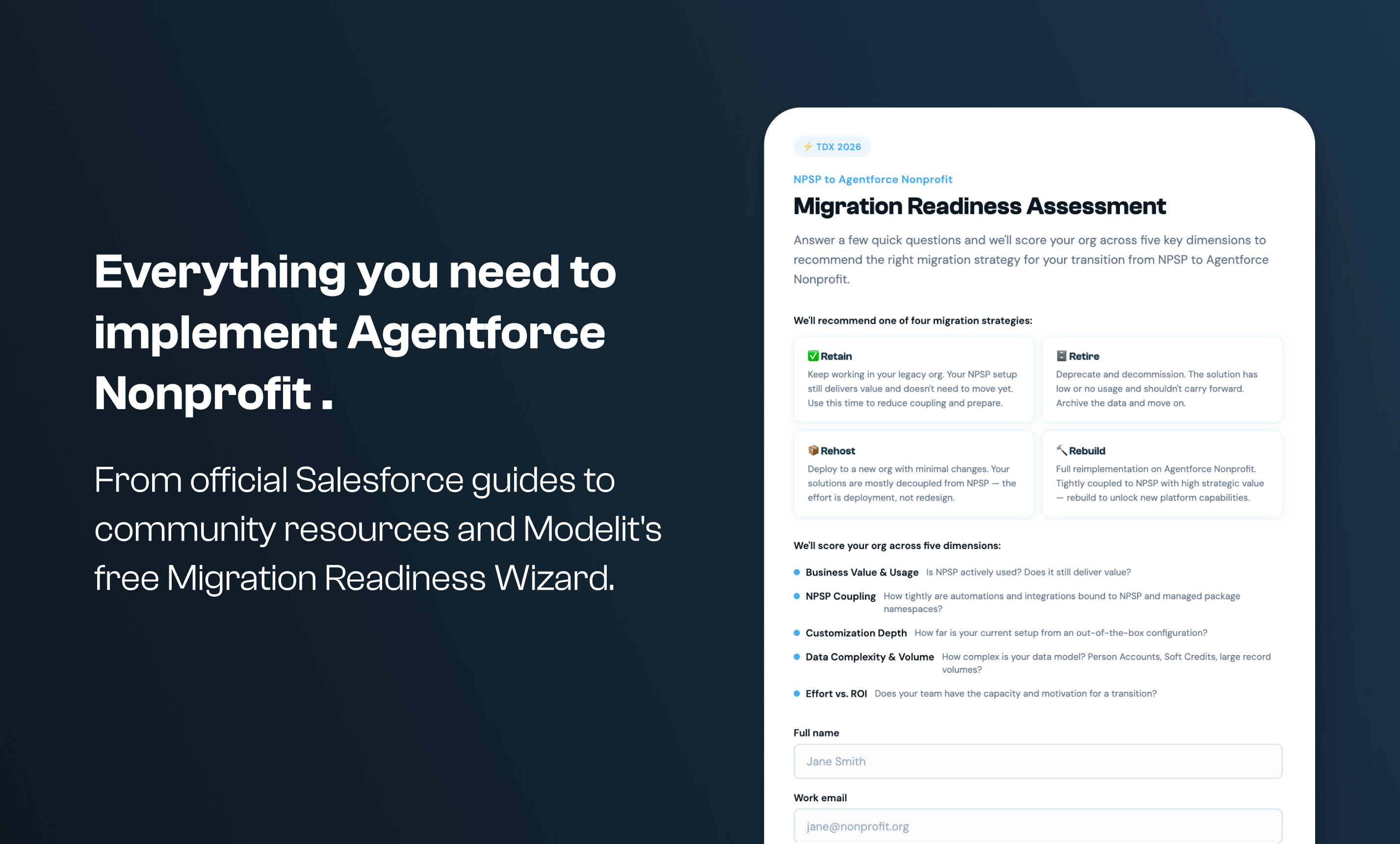
The ground is shifting. Nonprofit Cloud and Agentforce Nonprofit are real, and they’re not just rebranded NPSP. Our Migration Readiness Quiz is a quick gut check, and the Migration Readiness Assessment goes deeper if you’re seriously evaluating.
The part nobody says out loud
The real unlock isn't technical. It's confidence.
Most nonprofit staff I work with are smart, skeptical, and more than capable of understanding their CRM. What they’re missing is permission — permission to ask questions that might sound basic, permission to push back on a report that doesn’t smell right, permission to say “I don’t think we’re using this well” in a meeting where everyone’s pretending we are.
Fluency gives you that permission. Once you can read the system, you can question it. And once you can question it, you can improve it.
That's the whole game.
Up next: AI Fluency for Nonprofits on Salesforce
This is Part 1 of a 2-part series. Part 2 looks at what fluency means when AI enters the picture — what Claude for Nonprofits and Salesforce Headless 360 actually mean for your team, and the four leadership questions every nonprofit should be able to answer before letting AI near their Salesforce org. Coming soon.
Summary
Most nonprofits don't have a Salesforce problem — they have a fluency problem. Fluency isn't certification; it's the ability to navigate the platform, read a report critically, ask good questions of your admin, and know what your instance can and can't do. The gap is big in nonprofits because Salesforce is highly configurable, most training is admin-biased, implementation rarely includes lasting education, and the data model was built for sales teams. Fluent nonprofit users share five habits: they understand the data model in their own language, they can read (not just build) reports, they treat data hygiene as their job, they write good change requests, and they know their instance's real capabilities. Different roles need fluency in different areas, but the real unlock is confidence — the permission to question what you're looking at, and the ability to improve it once you can.


.webp)